
F-111 Production
General Dynamics won the US Department of Defense contract in 1962 to develop a supersonic aircraft under a program called TFX. This airplane, later designated F-111, would be the first in history to incorporate specific design features to make it capable of performing in multiple roles. General Dynamics built all F-111s at USAF Plant 4 in Forth Worth, Texas, USA. The same plant is now used by Lockheed Martin to build F-35 Lightning II Joint Strike Fighter (Trivia: the production line is just over a mile long, only in Texas !)
The F-111 is the first production airplane with a variable sweep wing—a wing configuration that can be changed in flight. The wing provided outstanding aerodynamic efficiency. With wings fully extended, the F-111 could take off and land in as little as 2,000 feet. With wings fully swept back, it could reach supersonic speeds at high or low altitudes. At high altitudes, the F-111 could fly more than twice the speed of sound, up to Mach 2.5 At low altitudes, the F-111 could fly supersonic speeds (> 850 knots+) hugging the ground with its terrain-following radar.
The F-111 could also fly trans oceanic distances without air-to-air refuelling and set a record for the longest low-level supersonic flight (172 miles at less than 1,000 feet altitude) on 9 November 1966. It was also the first tactical aircraft to cross the Atlantic from the United States to Europe without refuelling (in May 1967).
The F-111 was flown for the first time on 21 December 1964. In October 1967, the first version was delivered to the USAF Tactical Air Command at Nellis AFB, Nevada. Two years later, the first production bomber version was turned over to the Strategic Air Command at Carswell AFB in Fort Worth, Texas. A total of 562 F-111s were built. The first rolled off the production line on October 15, 1964. The last was produced in 1976.
F-111s Manufactured by GD – 562 aircraft
RDT&E 30 x F-111A (5 Attrited)
TAC 129 x F-111A (39 Attrited)
USN 7 x F-111B (2 Attrited)
RAAF 24 x F-111C (7 Attrited)
TAC 96 x F-111D (21 Attrited)
TAC 94 x F-111E (18 Attrited)
TAC 106 x F-111F (28 Attrited)
SAC 76 x FB-111A (14 Attrited)
RAF 2 x F-111K (nearly completed)
F-111s Modified by GD
TAC 42 x EF-111A (3 Attrited) Modified F-111A
TAC 34 x F-111G (0 Attrited) Modified FB-111A
RAAF 15 x F-111G (1 Attrited) Modified FB-111A
RAAF 4 x F-111G (0 Attrited) Modified F-111A
RAAF 4 x RF-111C (0 Attrited) Modified F-111C
TAC 1 x RF-111A (0 Attrited) Modified F-111A
RDT&E 1 x FB-111A (0 Attrited) Modified F-111A
F-111 Crew Module Ejections
80 F-111 ejections worldwide:
- 63 successful ejections
- 17 fatal ejections
- RAAF: 4 successful ejections; 1 fatal ejection
562 F-111s manufactured, 138 attrited
F-111 Aircraft Serial Numbers and Attrition – pdf
241013 F-111 Aircraft Serial Numbers and Attrition
(Disclaimer: tables derived from pdf table and www)
Aviation Safety Network Database – F-111
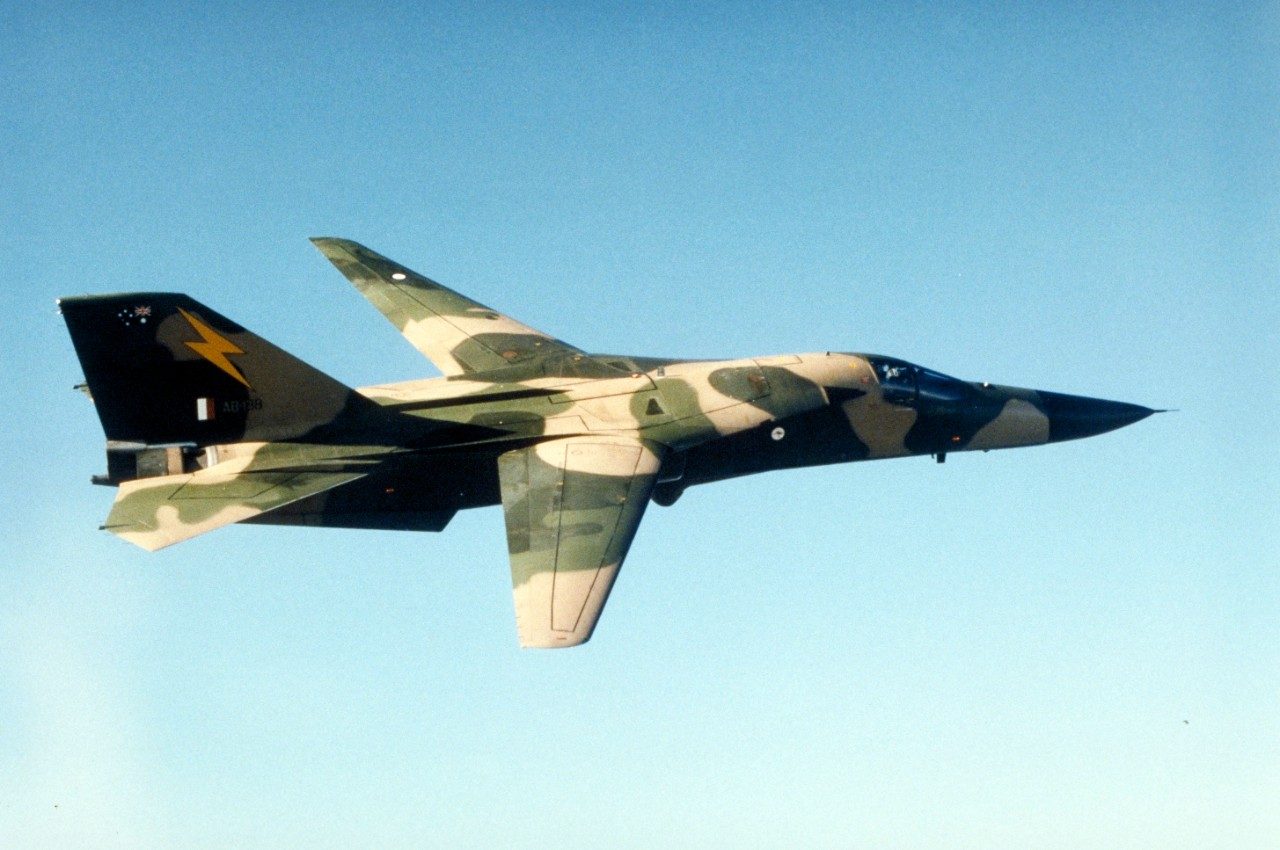
The operational career of the RAAF’s F-111s came to an end on 3 December 2010 at RAAF Base Amberley near Brisbane, Australia. Flying in a 6-ship formation and crewed by Andrew Kloeden and Micka Gray (Commanding Officer 6SQN), F-111C (serial number A8-125) was the last F-111 to touch down. 37 years earlier, Jake Newham and TC Owen flew that same aircraft into Amberley on 1 June 1973.
 Combat Operations
The F-111 first went into combat over Southeast Asia (Declassified Report: The F-111 in Southeast Asia, September 1972-January 1973) during the late 1960s, when flown as a penetrating bomber in both high and low-altitude missions. Nearly two decades later, F-111F USAF crews from RAF Lakenheath, England, used the highly accurate PaveTack target acquisition and laser-guided bombing system against terrorist targets in Libya during Operation El Dorado Canyon.
In January 1991, the F-111 went to combat again during the initial bombing raids of Operation Desert Storm. A total of 110 F-111s participated in nearly 5,000 sorties in the Gulf War in strategic bombing, ground attack and electronic warfare missions. With its PaveTack system, the F-111F attacked factories and other high-value military targets. F-111s were also credited with destroying more than 1,500 tanks and armoured vehicles employing ‘tank plinking’ tactics, best described by LTGEN ‘Buster’ Glossan’s Air Power Journal article – Summer 1993.
F-111 crews operated almost exclusively at night in the Gulf War. The aircraft dropped the bombs that stopped the flow of oil into the Gulf after Saddam Hussein opened pipelines to wreak environmental damage during the war. An unarmed EF-111A earned the first aerial victory of Desert Storm when its defensive manoeuvring caused a pursuing Iraqi fighter pilot to fly into the ground. The F-111 also dropped the first GBU-28, bunker-busting 5,000 pound laser-guided pound bombs. Those weapons had been developed in a matter of weeks to meet a critical need.
|
Operation |
Theatre | Dates |
Combat Losses |
|
COMBAT LANCER |
Vietnam | 1968 |
2 x F-111A |
|
CONSTANT GUARD V |
Vietnam | 1972-73 |
5 X F-111A |
|
EL DORADO CANYON |
Libya | 1986 | 1 x F-111F |
| DESERT SHIELD | Iraq | 1990 |
1 x F-111F |
|
DESERT SHIELD |
Iraq | 1991 |
1 x EF-111A |
Brief History of the F-111A
Originally known as the TFX (Tactical Fighter “X”), the F-111 was conceived to meet a U.S. Air Force requirement for a new tactical fighter-bomber. In 1960 the Department of Defense combined the USAF’s requirement with a Navy need for a new air superiority fighter. Production of the F-111 prototype began in the fall of 1963, and the first F-111 rolled out on 15 October 1964, 16 days ahead of schedule.
The first RDT&E YF-111A aircraft (SN 63-9766) was delivered on 16 October 1964 and flew on 21 December 1964. It used conventional ejection seats. The egress module was first fitted to F-111A No 12 (SN 63-9777). The first 30 F-111As were fitted with TF30-P-1 engines which experienced numerous compressor stalls at high speeds and high alpha. This required an engine upgrade to the TF30-P-3 and a new Triple Plow I intake system with variable geometry inlet ducts and larger areas. The first operational aircraft was delivered in October 1967 to Nellis Air Force Base, NV.
Notes
- The 3rd F-111A S/N 63-9768 was delivered to Australia to act as a training aid, located on RAAF Base Amberley
- The 11th F-111A S/N 63-9776 became the RF-111A
- The 13th F-111A S/N 63-9778 was transferred to NASA Dryden in 1973
- The 18th pre-production F-111A S/N 63-9783 became the FB-111A prototype
- S/N 67-0114 was the final F-111A built by GD and ended up being delivered to Australia as part of the F-111C attrition replacements in 1982
- Four F-111Cs were converted to RF-111C for RAAF
- One FB-111A crashed during acceptance testing and was never delivered to the USAF
- Two US Navy F-111Bs were under construction when the program was cancelled
- Two nearly complete RAF F-111Ks were turned over to the USAF as YF-111A and completed as FB-111A S/N 67-149/150
- RAF F-111Ks under construction (besides the first two) of the 50 ordered were completed as FB-111A
- EF-111A Raven – Grumman modify two F-111As into EF-111 prototypes in January 1975. The first fully equipped model, known then as the “Electric Fox”, flew on 10 March 1977, and deliveries to combat units began in 1981. A total of 42 airframes were converted at a total cost of US$1.5 billion, the last delivered in 1985.
The RAF strike aircraft replacement for their Canberra bomber’s was a saga, going from the ill-fated TSR2 program , to the short-lived F-111K option, to extending their Buccaneer force, then finally acquiring the Tornado
The US Navy’s F-111B program was cancelled as the aircraft weight ballooned to > 25 tons and thus the USN F-14 Tomcat Program began
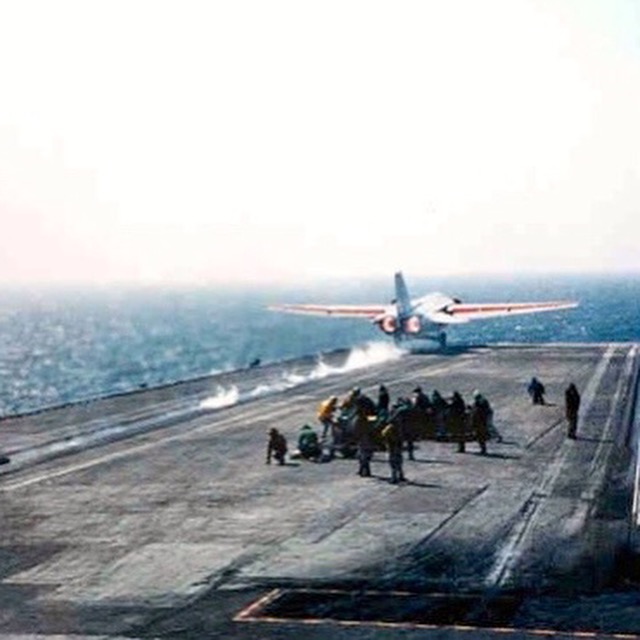
F-111B prototype (A2-05 / S/N 151974) blasting off the USS Coral Sea in July 1968 during carrier trials
An interested feature of the aircraft was its variable-geometry wings. While in the air, the wings could be manually swept forward to 160 for take-offs, landings or slow speed flight, and swept rearward to 720 for high-speed flight. The F-111 could also fly at very low level and hit targets in bad weather using its revolutionary automatic terrain following radar system. The F-111A’s initial operational testing finally came during its much-publicized Combat Lancer deployment to Thailand in 1968, an episode which demonstrated, tragically, that the aircraft was far from combat ready. Indeed, it was still undergoing Category I tests in 1972 and Cat II tests in 1973. Category III testing was ultimately skipped, altogether. In short, a minimally satisfactory “product” was seven years late in getting to its customer.
In 1972, after correcting early problems, the USAF returned the F-111A to Southeast Asia for Operation Linebacker II, where it conducted very effective night strikes against North Vietnamese targets. During a 1972 – 1973 tour of duty in Vietnam, F-111As flew more than4,000 combat missions. The early F-111As had extremely bad engine problems, suffering from compressor surge and stalls. NASA pilots and engineers wrung out the airplane in an attempt to solve its problems, studying the engine inlet dynamics of the plane to determine the nature of inlet pressure fluctuations that led to compressor surge and stall. Eventually, as a result of NASA, Air Force, and General Dynamics studies, the engine problems were solved by a major inlet redesign.